


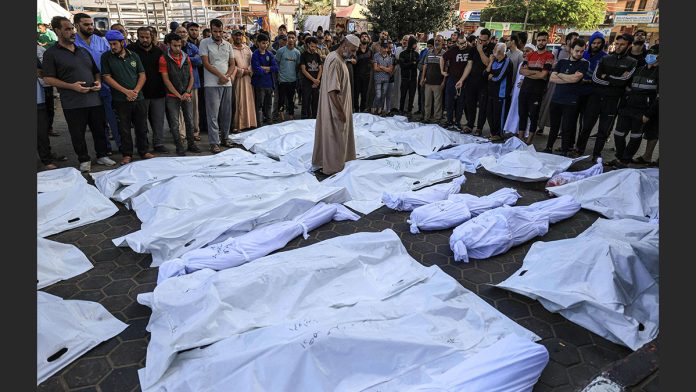

In the Nasser Hospital morgue, located in southern Gaza, the somber task of wrapping the bodies of those killed in Israeli airstrikes unfolds daily.
Amidst the pervasive scent of death, workers meticulously document basic information about the deceased: names, identity card numbers, ages, and genders.

Some of the bodies are severely mutilated, adding an extra layer of complexity to the identification process.
Only those bodies claimed by relatives or positively identified are eligible for immediate burial and inclusion in the Gaza Health Ministry’s official death toll.
Unclaimed bodies are consigned to the morgue’s refrigerated storage, often lingering there for weeks.
The Gaza Health Ministry’s death toll, standing at around 20,000 people as of Thursday, has drawn international attention to the significant number of civilian casualties resulting from the Israeli military’s offensive.
The toll, with around 70% comprising women and children, reflects the devastating impact of the conflict.
However, as the majority of Gaza’s hospitals close, hundreds of medical professionals perish, and communication infrastructure crumbles due to fuel and electricity shortages, compiling accurate casualty figures becomes an increasingly formidable task.
Morgue workers at Nasser Hospital, including volunteers, persevere amidst dire conditions, driven by the belief that documenting the Palestinian death toll is crucial.
Hamad Hassan Al Najjar, a dedicated worker, acknowledges the immense psychological toll, recounting the shock of discovering the disfigured bodies of friends and relatives, including the morgue’s director, who lost his life in an Israeli airstrike.
International efforts, involving Gaza-based health officials, academics, activists, and global volunteers, aim to prevent casualty figures from becoming victims of the worsening war conditions.
The data collected by these workers is centralized at an information center established by the health ministry at Nasser Hospital.
Since early December, the collapse of communication services and infrastructure in northern Gaza has hindered the ministry’s ability to collect regular reports from local morgues, according to the World Health Organization (WHO).
The WHO suggests that the ministry’s tally may be an undercount, considering that only six of Gaza’s 36 hospitals were operational as of Wednesday.
U.S. President Joe Biden expressed skepticism about Palestinian data on October 25, citing a lack of confidence. The ministry’s figures lack details on the cause of death and do not differentiate between civilians and combatants.
Despite Biden’s concerns, the United Nations, with a history of cooperation with Palestinian health authorities, continues to endorse the data’s quality.
The Palestinian Health Ministry, situated in the occupied West Bank and responsible for Gazan ministry workers’ salaries, reports a recent loss of contact with hospitals in Gaza.
Additionally, it lacks information on the fate of several hundred health workers arrested by Israeli forces, further complicating efforts to comprehensively document the human cost of the ongoing conflict.