


Amidst the tumultuous events unfolding in Israel and Gaza this fall, a remarkable trend is emerging – young Muslims are rallying support for the Palestinian cause in unexpected places across the United States.
One such instance is the story of 17-year-old Asmmaa Zaitar, a second-generation Palestinian American, who orchestrated a protest in the conservative town of Huntsville, Alabama.


Initially apprehensive about the response in a town known more for divisive debates on Confederate monuments than protests against overseas conflicts, Zaitar’s efforts proved successful.
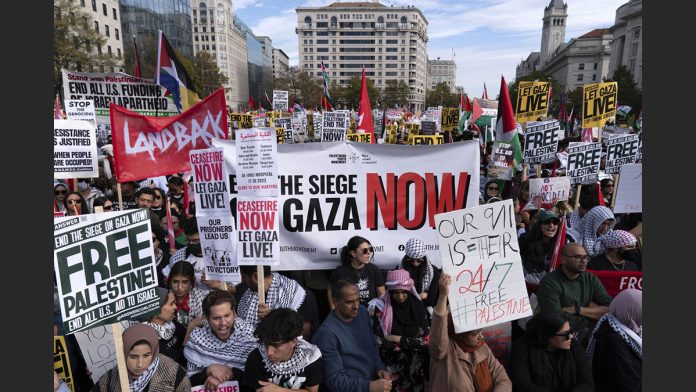
Dozens of fellow Muslims, including women in headscarves, gathered in late October, holding signs condemning Israel’s actions in the Gaza Strip. Local media coverage amplified the impact, solidifying a Palestinian voice in a community not traditionally associated with such activism.
This growing wave of support is not isolated but reflects a broader trend of the U.S. Muslim population spreading into the heartland of the country.
Young activists, many of whom are children of refugees from Muslim nations, are playing a pivotal role in shaping public opinion and advocating for a cease-fire in the Middle East.
Their efforts are creating a sense of community in areas where such gatherings were once unimaginable, and they are determined to continue influencing public discourse, highlighting the emerging political power of American Muslims.
Hammad Chaudhry, a 24-year-old second-generation Pakistani American involved in organizing pro-Palestine demonstrations at Appalachian State University in Boone, emphasized the interconnectedness of the world.
He stated, “We live in a globalized world where the tiniest thing somewhere can have a massive impact somewhere else.”
The recent surge in activism among young Muslims, a phenomenon considered unthinkable a decade ago, can be attributed to the geographical dispersion of Muslim families throughout the United States.
While earlier waves of migrants predominantly settled in states like New York, California, and Michigan, newer refugees from Muslim-majority nations have chosen states in the South or Midwest, seeking affordability.
Data from Pew Research Center indicates that approximately 3.45 million Americans are Muslim, with three-quarters being immigrants or their children.
The Muslim population, on average, is significantly younger than the overall U.S. population, with 35 percent aged 18 to 29.
A Washington Post analysis, based on religious institution data, revealed a noticeable increase in the number of Muslim congregations in 234 U.S. counties since 2000, indicating a broader geographical presence.
The activism is particularly pronounced in smaller areas witnessing significant growth in young Muslim populations.
Huntsville, for example, has experienced a rise from two congregations with 1,218 members in 2000 to four congregations with 3,935 members today.
Youssef Chouhoud, an assistant professor at Christopher Newport University, notes that young Muslims are now “coming of age” and engaging in Middle East politics in ways previous generations couldn’t.
While early waves of Muslim immigrants focused on assimilation and cultural adaptation, the current generation is more comfortable in their identity, willing to raise their voices on various issues.
The story of Khalil Abualya, a second-generation Palestinian American pre-med and pharmacy student at the University of Mississippi, exemplifies this trend.
Initially not expecting to become an antiwar activist at “Ole Miss,” Abualya’s perspective changed during his sophomore year when he discovered the Muslim Student Association (MSA).
The growth of MSA, with about 100 members, reflects the increasing Muslim presence in Oxford, Mississippi.
Driven by the urgency to address the Gaza crisis, Abualya and fellow MSA members organized a “silent protest” at a prominent student park. The event drew around 50 participants, marking the beginning of an ongoing effort to engage the community.
Abualya sets up a table near the student union regularly, sharing information about the conflict and fostering open dialogues.
In a region historically associated with stereotypes, Abualya’s experiences challenge preconceptions.
He states, “They just want to talk. They just want to hear about what is happening and have an open dialogue.”
The dialogue initiated by these young activists underscores the transformative power of their voices, challenging assumptions and contributing to a broader understanding of global issues in unexpected American heartlands.