


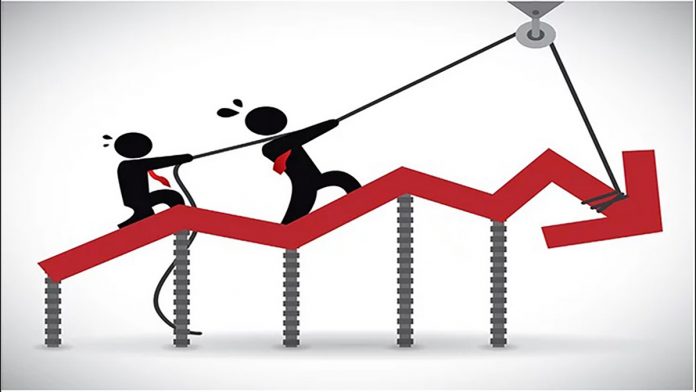

The extreme heat engulfing parts of China is a painfully apt metaphor for the economic temperature in Beijing.
The headlines of recent days can smack of cooling. Case in point: Asia’s biggest economy grew just 0.4% in the April-June quarter from a year ago. It was below forecasts of 1% and a world away from the 5.5% 2022 target.


But it’s the overheating risks emanating from China’s debt markets that are dominating investors’ attention. Some of the most extreme heat is being felt by China Evergrande Group and other property developers facing a mutiny among homeowners.
The problem: many Chinese took out huge mortgages for properties that remain unfinished. Homebuyers are either refusing to make payments or threatening to. This bubble has a number of economists worried China is giving off strong Lehman Brothers vibes as growth grinds to a halt.
Minxin Pei, China expert at Claremont McKenna College notes that confidence in the stability of mainland banks has been “badly shaken” by the failure of several small banks in Henan Province in April.
Since 2008-2009, when the Lehman crisis rocked the global financial system, China has been on a debt binge to support growth. Lots of it was issued by local governments far away from the real seat of power in Beijing. “Many have wondered how long the party could go on,” Pei explains.
Diana Choyleva at Enodo Economics points to another warning sign that things are amiss the globe’s biggest trading nation: mass bank protests in the city of Zhengzhou, the provincial capital of Henan, in recent months in response to accounts being frozen.
This pushback by “bank depositors demanding their life savings back and condemning government corruption is another manifestation of the huge challenges Beijing faces at present,” Choyleva says. “In China, whose citizens have no chance to express views through the ballot box, domestic bank runs can signal falling confidence in the system Xi tops.”
Clearly, investors betting on Japan-like reckoning in China haven’t made money these last 13-14 years. Time and time again, Communist Party leaders managed to steer China away from the rocks. Beijing did so by pushing China’s debt-to-GDP ratio to the verge of 265%.
Short-sellers who stepped forward to bet against Chinese government debt or the yuan over the last dozen years ended up closing those trades. Here, think hedge fund manager Kyle Bass, founder of Dallas-based Hayman Capital.
But China’s debt challenge is now colliding with two big threats, one from abroad and one homemade.
The first is a global inflation surge forcing the Federal Reserve to make its biggest tightening moves since the early 1990s. The second is President Xi Jinping’s “zero-Covid” lockdowns, which are backfiring—and fast.