


KABUL – Like other aspects of daily life in Afghanistan, the United States sanctions slapped on the country’s new administration have also undermined Afghans’ abilities to get preparation for the Eid al-Fitr celebration.
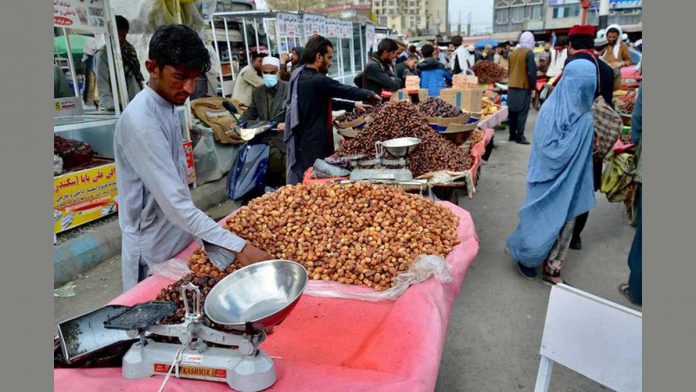
Abdul Sabir is a Kabul resident who visited a local market to buy dried fruits and clothes for his children to celebrate a joyful Eid al-Fitr but returned home with empty hands.


“I couldn’t buy anything for Eid al-Fitr, even couldn’t buy clothes for children, because the prices of everything including the dried fruits have gone up beyond our power purchase,” Sabir told Xinhua news agency.
“The bazaar has drastically lost hustle-bustle in compare with last year and people can’t buy what they want,” he added.
Traditionally, as part of their culture, the faithful Afghans buy fresh and dried fruits, cookies, confectioneries, and different kinds of dishes during the three-day Eid al-Fitr festival to mark the end of Muslims’ holy fasting month of Ramadan, which begins on Monday this year.
After the military withdrawal from Afghanistan, the US has slapped sanctions on the war-torn country and frozen over US$9.5 billion of its assets in the US banks.
“America has imposed sanctions on our country and has blocked our money in its banks,” a dried fruit seller Ahmad Jawad said.
Lamenting the skyrocketing prices of dried fruits in the market, Jawad said, “the price of 1 kg almond was 650 afghanis (US$7.55) last year but it costs 850 afghanis (US$9.88) in the current year.”
Echoing a similar feeling, a dried fruit shopkeeper named Mohammad Omar said that his business had been greatly affected by the increasing poverty among the Afghans impacted by the US sanctions.
“Last year ahead of Eid al-Fitr, I used to earn up to 25,000 afghanis (US$290) every day, but this year I can hardly sell dried fruits worth 10,000 afghanis (US$116) a day, although the number of buyers reaches its peak,” he said.