


KUALA LUMPUR – In conjunction with World Cancer Day today, Prime Minister Tan Sri Muhyiddin Yassin called on the people from all walks of life to play their parts in preventing and fighting the disease by adopting a healthy lifestyle.
In his Facebook post, Muhyiddin, who is also a cancer survivor, shared his experience in fighting cancer, saying that he understood the pain and the suffering of cancer patients in battling the disease.


“Words of encouragement and support from family members strengthened my spirits to continue to fight and face this disease. Alhamdulillah, I am grateful to Allah that after completing the treatment, I was told that I am now cancer-free,” he said.
Muhyiddin said that apart from the comprehensive treatment, early detection and quick action to seek treatment can increase the chances for patients’ recovery.
Therefore, the Prime Minister advises the public to do regular health screening tests to avoid late detection of cancer.
“Go for early screening, and most importantly, undergo treatment immediately if you are diagnosed with cancer. Do not be afraid or procrastinate.
“All types of illness, God willing, can be treated well if detected early and treated properly,” said Muhyiddin.
In the same post, the Prime Minister also advised Malaysians who are fighting cancer to remain optimistic.
“Many chronic patients including those with cancer whom I know have successfully fought the disease and are now living normal lives.
“If you are battling cancer, strengthen your spirits — you are not alone,” he added.
In the post, Muhyiddin also used the hashtag #SayaAkandanSayaBoleh and #IAmAndIWill which is the theme of the World Cancer Day celebration.
Early screening
The Health Ministry in a related development, urged the public to go for early screening for cancer, as well as to know the early signs and symptoms of the disease, to avoid detecting it at a late stage and for a better chance of recovery.
Health Director-General Tan Sri Dr Noor Hisham Abdullah said early detection, as well as quick and effective treatment, provided a good chance for patients to recover.
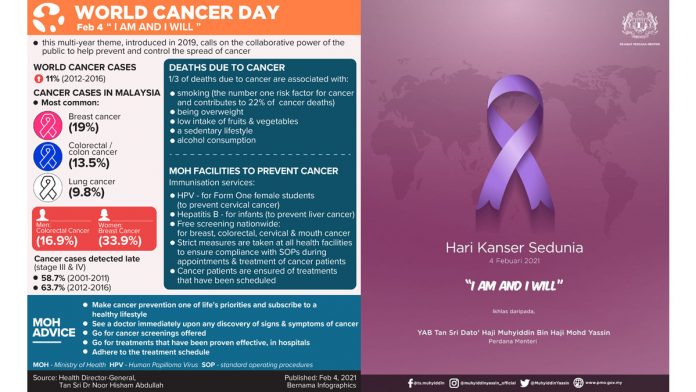
“The overall percentage of cancer cases detected late (stage III and IV) increased from 58.7 percent between 2001 and 2011 to 63.7 percent in 2012 to 2016.
“This situation is worrying and needs to be given due attention,” he said in a statement in conjunction with World Cancer Day today.
This year’s World Cancer Day, with the theme ‘I Am and I Will’ , aims to get the public to support and participate in efforts to prevent and control cancer.
Dr Noor Hisham said the ministry was always committed in encouraging the public to adopt a healthy lifestyle.
“The ministry also provides Human Papilloma Virus (HPV) immunisation service for Form One female students to prevent cervical cancer and Hepatitis B immunisation for infants to prevent liver cancer.
“The ministry also provides free screening for breast, colorectal, cervical and mouth cancer nationwide for free, while at private facilities, at a certain fee will be charged,” he said, adding that those who are diagnosed with cancer, they need to seek treatment immediately.
Patient well-being important
He said the ministry is very concerned about the health and well-being of cancer patients, especially during the COVID-19 pandemic.
“This is because cancer patients have a low immune system compared to others and are more at risk of getting serious infection,” he added.
As such, he said, strict control measures are taken at all health facilities to ensure compliance with standard operating procedures (SOPs) during appointments and treatment of cancer patients.
Dr Noor Hisham said cancer is one of the most feared chronic diseases and can have a high negative impact on patients, families and the country, with breast cancer being the most common, at 19 percent, followed by colorectal or colon cancer (13.5 percent) and lung cancer (9.8 percent).
“Among men, colorectal cancer is the most common cancer at 16.9 percent and among women, it is breast cancer (33.9 percent),” he added.
He said one-third of death due to cancer is associated with, among others, overweight, low intake of fruits and vegetables, poor physical activity, smoking and alcohol consumption.
Smoking is the most important risk factor for cancer and contributes to 22 percent of death due to cancer, he added.