


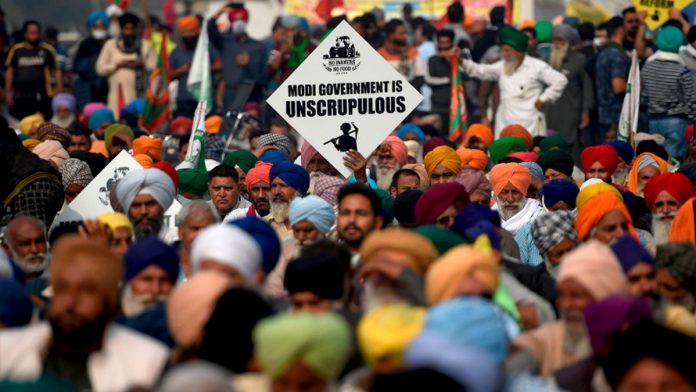

NEW DELHI – The Indian government has ordered suspension of internet services in borders outside national capital amid farmers’ protests, officials said Saturday.
According to officials, the service has been suspended in areas of Singhu, Ghazipur and Tikri – epicenters where thousands of farmers are occupying roads for over two months against the federal government’s controversial three farm laws.


“It is necessary and expedient to order the temporary suspension of internet services in the areas of Singhu, Ghazipur and Tikri, and their adjoining areas in the National Capital Territory (NCT) of Delhi from 11:00 p.m. (local time) on Jan. 29 to 11:00 p.m. (local time) on Jan. 31,” read a notification issued by the federal home ministry.
The step, according to the ministry, has been taken to “maintain public safety and averting public emergency.”
This is the second such suspension taking place in a week.
On Tuesday (Jan. 26), the internet was suspended in many parts of Delhi immediately after farmers’ tractor rally entered into the capital city, triggering clashes between them and government forces. One farmer died and many others including policemen were injured in the clashes.
“If the administration is thinking that by suspending internet services they will be able to stop the movement, they are grossly mistaken. The more they want to muzzle farmers’ voices, the larger the protest will go,” Bharatiya Kisan (farmer) Union spokesperson Rakesh Tikait said.
On Friday opposition parties in India boycotted the President Ram Nath Kovind’s address to the parliament.
Eleven rounds of talks between protesting farmers and the federal government have failed to end the ongoing stalemate.
Ever since the protest broke out against the laws, Indian Prime Minister Narendra Modi has been defending them as major reforms for the upliftment of farmers.
Solve problems together
UN Secretary-General Antonio Guterres in a related development, has urged India and Pakistan to “come together” and solve their problems as any military confrontation would be a disaster.
“Our good offices are always available (for mediation) and we will insist within it… finding peaceful solutions for problems that have no military solution,” he said at a news conference at UN headquarters in New York that was aired live late Thursday.
Guterres was referring to his statement made on the disputed Jammu and Kashmir region after India unilaterally annexed the region Aug. 5, 2019, Anadolu Agency reported.
The UN chief encouraged the resolution of the Kashmir dispute according to UN resolutions and its charter.
“It is clear when seeing Pakistan and India, any military confrontation between the two would be a disaster of unmitigated proportions for both countries and for the whole world,” said Guterres.
“(It) is absolutely essential to have a de-escalation of the situation, namely in the Line of Contact (Line of Control, or LoC),” he said, referring to the dividing line in Jammu and Kashmir which has seen a recent escalation of cease-fire violations.
The UN deployed a military observer group (UNMOGP) on the two sides of the LoC to monitor the cease-fire and Pakistan last month accused India of “specifically targeting” UNMOGIP officials in the Chirikot sector of Azad Jammu and Kashmir along the LoC.
New Delhi has denied involvement.
“It is essential that human rights are fully respected in all territories,” he said.
A report by the Legal Forum for Kashmir assessing the human rights situation in India-administered Kashmir in 2020 said 474 people, including 232 suspected militants and 177 Indian troops, were killed in the region.
Sixty-five civilians were killed “extrajudicially,” the report claimed.
Indian authorities said 225 militants were killed in Jammu and Kashmir last year while 16 policemen and 44 Indian soldiers died in operations or militant attacks.
Last year, during a visit to Pakistan in February, the UN chief emphasised de-escalation and diplomacy in the resolution of the Kashmir dispute.
“UN Security Council resolutions (should) be implemented, humans rights respected and continental freedoms” allowed in the Himalayan region, he said.
“In relation to the ceasefire, I visited UNMOGIP. We believe that UNMOGIP should have full freedom of movement. It has on the Pakistani side, we hope that this will also be achieved on the other side. We will be strengthening its equipment capacity in order to better be able to implement its mandate,” Guterres said at a news conference in Islamabad alongside Pakistani Foreign Minister Shah Mahmood Qureshi.