


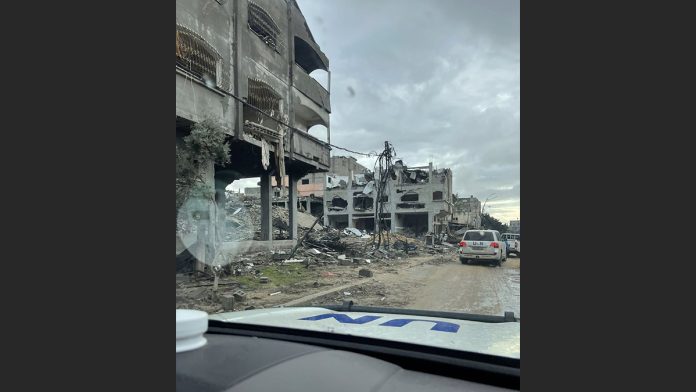

Amidst cautiously optimistic hopes for an agreement to extend the temporary cessation of hostilities in Gaza between Israel and Hamas, the United Nations Relief and Works Agency for Palestinian Refugees (UNRWA) has reported a significant breakthrough in the delivery of humanitarian assistance to shelters in northern Gaza.
This development comes after weeks of intense conflict that has left Gaza City resembling a ghost town, its streets eerily deserted as a result of heavy airstrikes and shelling.


Thomas White, the Director of UNRWA Affairs in Gaza, vividly described the visible impact of the recent violence: “As we drove through Gaza City, it was like a ghost town; all the streets were deserted.
The impact of heavy airstrikes and shelling was so visible. Roads are riddled with craters, complicating aid deliveries.”
The sixth and final day of a truce brokered by Qatar between Hamas and Israel is currently underway, with humanitarians urging both sides to heed international calls for an extension of the ceasefire.
During this temporary pause in hostilities, at least 85 hostages held by Hamas have been released, and over 180 Palestinian prisoners have been freed by Israel.
The humanitarian community has seized this opportunity to enhance aid deliveries into and across Gaza, with organizations such as the Egyptian and Palestinian Red Crescent Societies, along with UN agencies, actively participating in the distribution efforts.
Despite the challenges posed by the war-ravaged landscape, aid coordination offices, including the UN’s Office for the Coordination of Humanitarian Affairs (OCHA), have managed to navigate through the obstacles to provide essential assistance.
OCHA’s latest update highlighted the successful delivery of a convoy by the Palestine Red Crescent Society to northern Gaza on Tuesday.
The convoy, carrying crucial supplies such as food, medical items, water, and non-food essentials, is a lifeline for the displaced population, primarily concentrated in the southern regions of Gaza.
In a poignant statement, UNRWA revealed that a six-truck convoy had reached Jabalia, the largest and most densely populated refugee camp in Gaza, located north of Gaza City.
Despite facing personal tragedy, UNRWA staff in Jabalia, including a sanitation services chief who lost his wife and daughter, continue to serve their communities tirelessly.
Since the initiation of the ceasefire on November 24, approximately 200 aid trucks have been able to cross into Gaza via Egypt every day.
Images provided by UNRWA showcase volunteers unloading sacks of supplies into a warehouse and filling static fuel tanks, symbolizing a critical lifeline for a population grappling with the aftermath of extensive conflict.
The toll on Gaza’s population has been devastating, with more than 15,000 Gazans reportedly killed during Israeli airstrikes, including approximately 6,000 children, according to health authorities in the enclave.
This humanitarian crisis has also raised concerns about the spread of diseases among the displaced population.
In a related development, Tedros Adhanom Ghebreyesus, the head of the World Health Organization (WHO), issued a fresh warning about the high risk of diseases spreading among those displaced by the violence.
He emphasized the dire living conditions and lack of healthcare, stating that the risk of more people succumbing to diseases than bombings is a grave concern.
The latest data from WHO indicates alarming numbers of acute respiratory infections, cases of diarrhea, and tens of thousands suffering from scabies, lice, skin rashes, and jaundice.
UNRWA reports that more than 1.8 million Gazans, comprising around 80% of the enclave’s population, have been displaced since the initial terror attack by Hamas on southern Israel in October.
This mass displacement, fueled by escalating violence, has exacerbated the already dire humanitarian situation in the region.
Against this backdrop, the delicate truce represents a brief window of opportunity for humanitarian organizations to deliver much-needed assistance to the affected population in Gaza.
However, the overarching concern remains the urgent need for a sustainable, long-term solution to the underlying political tensions to prevent the recurrence of such devastating conflicts in the future.