

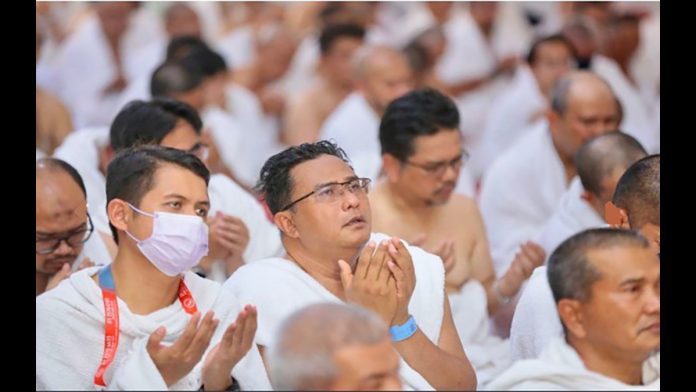

KUALA LUMPUR – Khatijah Ali made the selfless decision to turn down the Haj Financial Assistance offered by Lembaga Tabung Haji (TH) this year with the noble intention of extending it to prospective pilgrims in greater need.
The private sector retiree from Melaka viewed the decision as ‘sedekah’ (alms) or her contribution to help more people aspiring to perform the pilgrimage benefit from the assistance.

Khatijah, 63, decided to pay the full haj cost of RM30,850 instead of the RM19,870 she was offered through TH’s Haj Financial Assistance.
“I began saving with Tabung Haji on Feb 2, 2007, and registered for the Haj on Jan 7, 2009. I have enough savings, so I decided not to take the offered assistance to help others,” she told Bernama.
Haj Financial Assistance is an initiative introduced by TH as an Islamic financial institution to aid first-time pilgrims from the B40 and M40 groups.
TH has allocated RM400 million this year to cover the cost of performing the Haj for the groups, and it will continue to fund the aid in a targeted manner despite the cost of performing the pilgrimage increasing to RM30,850 this year from RM28,632 last year.
An agricultural project operator in Perak who only wished to be known as Saleh, 48, meanwhile said he held on to the concept of istita’ah or one’s capability to perform this religious duty.
“I chose to use my own savings, which my parents began in Tabung Haji in the early 80s, which I continued when I got older. Although I was offered the Haj Financial Assistance, I believe it’s better for me to bear the entire cost of performing the Haj on my own.
“Moreover, my savings were enough to cover the entire cost. By not taking it (the assistance), at least it can be channelled to those who need it more,” he added.
Saleh, who was supposed to perform the Haj in 2022 but had to postpone it due to COVID-19, was placed in this year’s Haj queue and had been offered RM10,850 in Haj financial assistance for the B40 group to perform the pilgrimage last June.
Meanwhile, senior lecturer at Universiti Utara Malaysia’s School of Economics, Finance and Banking, Dr Nur Hafizah Mohammad Ismail said the targeted Haj Financial Assistance will alleviate the burden of Haj pilgrims who might face financial difficulties in performing the pilgrimage for the first time.
She described the assistance as inclusive, as it ensures that all pilgrims, regardless of their financial backgrounds, have the opportunity to perform the pilgrimage.
In response to the decision of some Haj Financial Assistance recipients to pay the full Haj cost, Nur Hafizah said that any unused funds can be redistributed as dividends to TH depositors in the subsequent year.
“I believe it can further enhance TH’s financial performance, especially dividends. However, if the expenditure for Haj Financial Assistance increases in tandem with rising operational costs, this will have an effect on dividend rates for depositors,” she said.
Nur Hafizah was of the opinion that TH should review its selection criteria for pilgrims from the B40 and M40 categories if a significant number of those who were offered the targeted Haj Financial Assistance declined it.
“TH should also enhance its policies, strategies, and approaches in providing financial assistance to those in need.
“I also believe that the surplus funds could potentially be used for selected Haj pilgrims within the quota, helping those who need more assistance due to financial constraints, depending on specific circumstances,” she said.
She also welcomes TH’s effort to introduce a targeted assistance structure this year that takes into account variations in income and financial capacity among Haj pilgrims within the three primary categories – B40, M40, and T20 groups.
“Unlike the two categories in 2022, which were B40 and non-B40 groups, the targeted haj payment structure is beneficial for a more inclusive haj implementation that takes into account socio-economic factors such as social justice and financial capability,” she added.- Bernama